Leadership Compass: Developing the Organization, Systems and   Transformation

What is a Leadership Compass exercise?

  • Please refer to this post: Four Rooms of Leadership
  • I recommend starting your use of the Leadership Spiral with the set of questions provided in that post…
  • … and return here once you are familiar with the Leadership Compass exercises of the Leadership Spiral.

Leadership Compass: “Leading the Organization and Systems through Continuous Change

Leading an organization today means leading through continuous change, not episodic transformation. Markets shift, strategies evolve, structures stretch, and growth introduces new layers of complexity faster than certainty can keep up. In this reality, leadership is less about prediction and control—and more about sense-making, coherence, and responsibility for the whole system.

The reflective questions in this Leadership Compass focus on developing system-aware leadership: the ability to see patterns instead of isolated issues, to act with intention rather than reactivity, and to hold purpose steady while everything else moves. They invite leaders to examine not only what they do, but how their assumptions, fears, and habits shape the organization’s capacity to adapt and scale.

Upscaling an organization is not merely a structural challenge. It is a leadership challenge. As systems grow, direct control becomes less effective, and leadership shifts from managing outcomes to enabling self-correction, learning, and evolution. These questions support leaders in making that shift consciously.


🌱 Leading Myself (Me)

Becoming a system-aware leader who acts with purpose and humility.

  • What stories do I tell myself about how “change” should look — and how might those limit real transformation?
  • How do I stay grounded in uncertainty, when results aren’t linear or immediate?
  • What part of me resists letting go of control when systems need to self-correct?
  • How do I maintain connection to purpose while navigating power and politics?

🤝 Leading One Other Person (You)

Engaging others as partners in shaping and sensing systemic change.

  • How do I invite this person into the larger story of transformation, not just their own role in it?
  • When they resist change, what might they be protecting that’s valuable to the system?
  • How do I help others see patterns, not just problems?
  • What conversations would help this person grow their own systemic awareness and influence?

👥 Leading a Team

Turning teams into change agents and learning hubs.

  • How does this team act as a microcosm of the larger organization — what patterns do we amplify or challenge?
  • What learning loops can we strengthen so the team becomes more adaptive and self-correcting?
  • How do we connect team purpose explicitly to the organizational mission and ecosystem?
  • What would make this team a model others want to emulate — and how can I enable that without turning it into a showcase?

🏛 Leading in the Organization

Seeing, influencing, and evolving the system as a whole.

  • What is the current stage of evolution of our organization — and what leadership capacities does that stage require?
  • Where are structures, culture, and strategy misaligned — and how might I convene the right people to realign them?
  • How do I nurture the organization’s ability to sense and respond, rather than predict and control?
  • What symbols, stories, and rituals could embody the next phase of our collective evolution?

The Responsibility of Systemic Leadership

Leading an organization in uncertain times requires a different kind of strength. Not the strength of having answers, but the strength to stay present when answers are incomplete. Not the strength of control, but the courage to let systems respond while holding clear direction and purpose.

Systemic leadership means accepting responsibility for:

  • how change is framed and experienced,
  • how power and politics are navigated without losing integrity,
  • and how growth is enabled without fragmenting the organization.

The work is never finished. As organizations evolve, leadership capacity must evolve with them. Leaders who engage in this ongoing reflection do more than manage transformation—they become stewards of the system, shaping conditions in which people, teams, and the organization as a whole can sense, learn, and respond effectively.

In times of constant change, the greatest risk is not moving too slowly. It is leading with outdated assumptions.

These questions are an invitation to update not just strategies or structures—but the way leadership itself is practiced, again and again, as the organization grows into its next stage.es. It is created by leaders who are willing to examine their own impact—and who choose, repeatedly, to lead in a way that makes working together both possible and worthwhile.

Leadership Compass: Fostering Collaboration and Teams

What is a Leadership Compass exercise?

  • Please refer to this post: Four Rooms of Leadership
  • I recommend starting your use of the Leadership Spiral with the set of questions provided in that post…
  • … and return here once you are familiar with the Leadership Compass exercises of the Leadership Spiral.

Leadership Compass: “Fostering Collaboration and Teams

Team communication and collaboration is a Leadership Challenge! Collaboration does not fail because people are unwilling to work together. It fails because leadership behavior quietly shapes how safe, useful, and worthwhile collaboration feels. Every leader—through presence, language, and decisions—sets the tone for how information flows, how disagreement is handled, and whose voices matter.

The questions in this Leadership Compass focus on communication and collaboration across four segments of the Leadership Spiral. They invite leaders to look beyond tools and formats and examine the human dynamics beneath them: trust, power, impatience, control, and shared ownership.

These reflections are not about becoming more agreeable. They are about becoming more conscious—of how personal patterns scale into team dynamics, and how small leadership behaviors either enable or inhibit collective intelligence. Communication and collaboration are not team skills alone. They are leadership practices.


🌱 Leading Myself (Me)

Understanding how my mindset and behavior influence team dynamics.

  • How do I show up in groups — do I naturally take space, hold space, or avoid it?
  • What part of teamwork triggers my impatience, and what might that reveal about me?
  • How do I manage the tension between wanting control and trusting collective intelligence?
  • What do I personally need to practice to be a better collaborator, not just a better leader?

🤝 Leading One Other Person (You)

Strengthening collaboration through trust and transparency in 1:1 relationships.

  • How do I handle disagreement in a way that builds rather than erodes connection?
  • In what ways do I help others see how their work connects to the whole?
  • What does this person need from me to collaborate courageously — safety, clarity, or challenge?
  • How do I nurture shared ownership instead of dependency in our relationship?

👥 Leading a Team

Creating the conditions for collective learning, autonomy, and shared purpose.

  • What norms or habits in this team strengthen collaboration — and which quietly weaken it?
  • How do we learn together as a team, not just work together?
  • When conflict arises, do we treat it as a failure of harmony or an invitation to deepen trust?
  • What can I do to ensure every voice contributes to shaping direction, not just executing it?

🏛 Leading in the Organization

Building bridges and collaboration across teams and systems.

  • Where are the key interfaces in our organization that most need better collaboration — and what’s my role in improving them?
  • How do I enable teams to align around shared purpose while keeping their autonomy intact?
  • What invisible boundaries or incentives keep teams from working together effectively?
  • How do I role-model collaboration across silos — especially when it costs time, status, or comfort?

The Ongoing Work of Enabling Collaboration

Fostering communication and collaboration is one of the most demanding tasks of leadership precisely because it cannot be delegated or standardized. It requires leaders to work with ambiguity, tension, and difference—without rushing to control or consensus.

Strong collaboration emerges when leaders:

  • regulate themselves before intervening,
  • create space for productive disagreement,
  • and consistently reinforce shared ownership over individual authority.

This is not a one-time achievement. As teams change, pressure increases, and systems grow more complex, collaboration must be re-established again and again. Leaders who take this responsibility seriously do not just improve teamwork—they expand the organization’s capacity to think, learn, and act together.

In the end, collaboration is not created by better meetings or clearer rules.
It is created by leaders who are willing to examine their own impact—and who choose, repeatedly, to lead in a way that makes working together both possible and worthwhile.

Meditation Exercise: Arriving Fully

Here is a clear, grounded meditation exercise that works well for calming without being fluffy, reflective without drifting into esoterics.

Duration: 8–12 minutes
Intention: To shift from doing into being, and from reactivity into presence.

Preparation

Sit upright, feet on the floor, spine long but relaxed.
Rest your hands loosely on your thighs or in your lap.
If it feels comfortable, close your eyes. Otherwise, soften your gaze.

Take a moment to arrive.
Nothing to fix. Nothing to achieve. Just arriving.


Step 1: Grounding the Body

Bring your attention to the points of contact:

  • your feet touching the floor,
  • your body supported by the chair,
  • the subtle weight of your hands.

Notice the stability underneath you.
Let the body be held.

Take three slow breaths:

  • inhale through the nose,
  • exhale through the mouth, slightly longer than the inhale.

With each exhale, allow tension to drop—especially from shoulders, jaw, and forehead.


Step 2: Following the Breath

Now let the breath return to its natural rhythm.
Do not control it. Simply observe it.

Notice:

  • where you feel the breath most clearly,
  • the gentle rise and fall,
  • the pause between breaths.

When the mind wanders—and it will—acknowledge it without judgment and gently return to the breath.
This returning is the practice.


Step 3: Observing Thoughts and Emotions

Shift your attention slightly outward.
Notice thoughts as they appear—like clouds moving across the sky.

Do not follow them.
Do not push them away.

Just note:

  • “thinking,”
  • “planning,”
  • “remembering.”

If emotions arise, allow them to be present without analysis.
You are not required to act on anything right now.


Step 4: Centering in Choice

Bring awareness to the space between stimulus and response.

Ask yourself silently:

  • What is present right now?
  • What choice do I have in how I meet this moment?

Do not look for answers.
Let the questions settle.

Notice the quiet clarity that often emerges when nothing is demanded.


Step 5: Closing

Take a slightly deeper breath in.
Exhale fully.

Gently move fingers and toes.
When ready, open your eyes.

Before returning to activity, pause for one final moment and name one quality you want to bring into the next part of your day—calm, focus, courage, or kindness.

Carry that quality with you.


Why This Works

This exercise trains the capacity to:

  • notice without reacting,
  • slow down internal noise,
  • reconnect with intentional choice.

Practiced regularly, it strengthens self-leadership—the ability to respond rather than react. And that, quietly but reliably, changes how leadership shows up.

Leadership Compass: Developing People, Growing Leaders

What is a Leadership Compass exercise?

  • Please refer to this post: Four Rooms of Leadership
  • I recommend starting your use of the Leadership Spiral with the set of questions provided in that post…
  • … and return here once you are familiar with the Leadership Compass exercises of the Leadership Spiral.

Leadership Compass: “Developing Others, Growing People“

If leadership is understood as responsibility, then growing leaders is not an optional extra—it is a core task. Leaders who focus only on results, delivery, or performance optimization eventually hit a ceiling. Leaders who grow other leaders raise that ceiling—for themselves, their teams, and the organization.

Here is why this matters:

  • 1. Complexity Has Outgrown Individual Leadership
  • 2. Leadership Capacity Is Not Transferable by Instruction Alone
  • 3. Culture Is Shaped by Who Is Allowed to Lead
  • 4. Sustainable Performance Requires Inner Leadership
  • 5. Legacy Is Measured in Capability, Not Control

🌱 Leading Myself (Me)

Cultivating the mindset and presence that make growth in others possible.

  • What beliefs do I hold about people’s capacity to grow — and how do those beliefs show up in my behavior?
  • When someone around me grows, what part of me resists or feels threatened?
  • How do I model continuous learning in a way that’s visible and authentic?
  • What kind of space do I create — consciously or unconsciously — for others to experiment, fail, and learn?

🤝 Leading One Other Person (You)

Empowering, coaching, and unlocking potential.

  • Do I see this person primarily through their current performance or their emerging potential?
  • How do I balance guidance with autonomy when supporting their development?
  • What patterns do I notice in the feedback I give — is it developmental, evaluative, or protective?
  • What conversations have I avoided that could actually unlock growth for them?

👥 Leading a Team

Enabling collective learning and shared leadership.

  • How does this team learn — and what’s my role in accelerating that learning cycle?
  • Which team members are already showing leadership — and how can I help that become visible and contagious?
  • How do I make room for multiple voices, even when it slows things down?
  • What team rituals or structures support peer coaching, shared accountability, and experimentation?

🏛 Leading in the Organization

Growing leadership capacity across systems and shaping a learning culture.

  • How does our system currently identify and nurture emerging leaders — and what’s missing?
  • What barriers (structural or cultural) keep people from stepping into leadership, and how can I help remove them?
  • Where could I sponsor or mentor beyond my immediate circle to expand leadership capacity across boundaries?
  • How do I contribute to an environment where leadership is a shared capability, not a position?

The Leadership Choice

Every leader, consciously or not, makes a choice:

  • to be the smartest person in the room, or
  • to build rooms where leadership intelligence multiplies.

Growing leaders requires patience, humility, and the willingness to let go of being central. But it is the only way leadership scales without losing its humanity.

In the end, leaders are not remembered for how much they carried themselves—
but for how many others learned to carry responsibility with them.

The 5 Basics of a Team

Find here valuable insights about the essential and basics for a team to thrive. It is intentionally written from a leadership perspective, not as a team facilitation guide—because this is where the real leverage is, and this article addresses leaders!


Why leaders must get these right—before asking for performance

Most leaders know the model of the five dysfunctions of a team, introduced by Patrick Lencioni in his book The Five Dysfunctions of a Team. What is less often discussed is this: If dysfunctions describe what breaks teams, then basics describe what leaders must actively build and protect.

Teams do not fail because people are unwilling. They fail because leaders underestimate what teams need to function.

Below are the five basics of a team—and why each of them is a leadership responsibility.


1. Trust – The Foundation of Everything

Trust is not about being nice or getting along. It is about psychological safety: the confidence that I can speak openly, admit mistakes, ask for help, and disagree without fear of humiliation or retaliation.

Without trust:

  • feedback becomes political,
  • mistakes get hidden,
  • learning slows to a crawl.

Why this matters to leaders:
Trust does not emerge from team-building exercises. It emerges from leader behavior. Leaders who admit uncertainty, own mistakes, and invite challenge make trust possible. Leaders who perform certainty and perfection quietly kill it.

No trust. No team. Just coordinated individuals.


2. Conflict – Productive Tension Instead of Artificial Harmony

Healthy teams argue. They challenge assumptions, test ideas, and surface differences early—before they turn into passive resistance.

What teams need is not less conflict, but better conflict:

  • focused on ideas, not people,
  • direct rather than whispered,
  • resolved rather than avoided.

Why this matters to leaders:
Leaders set the tone for conflict. If you shut down dissent—intentionally or not—you train people to disengage intellectually while appearing compliant. That is not alignment. That is silence.

If there is no conflict in your leadership team, you are not hearing the truth.


3. Commitment – Clarity Beats Consensus

Commitment does not require unanimous agreement. It requires clarity and closure.

Teams commit when they understand:

  • what has been decided,
  • why it was decided,
  • and what is expected now.

Ambiguity is the real enemy here—not disagreement.

Why this matters to leaders:
Leaders often mistake endless discussion for inclusiveness. In reality, teams need leaders who can listen deeply and then decide clearly. Commitment comes from knowing where we stand, not from endless alignment loops.

Unclear decisions create hesitation. Clear decisions create movement.


4. Accountability – Holding Each Other to the Standard

In strong teams, accountability is not top-down enforcement. It is peer-to-peer ownership. Team members care enough about the shared goal—and about each other—to address missed commitments directly.

Without accountability:

  • standards erode,
  • resentment grows,
  • leaders become bottlenecks.

Why this matters to leaders:
Leaders must model accountability before expecting it. If you avoid hard conversations, your team will too. If you tolerate low standards at the top, they will spread faster than any value statement.

Accountability is not control. It is respect for the team’s purpose.


5. Results – The Discipline to Prioritize the Collective Outcome

Teams exist to achieve results—not individual success stories. When personal goals, departmental metrics, or ego take precedence, team performance suffers.

A focus on results means:

  • putting team outcomes above personal wins,
  • making trade-offs visible,
  • measuring what actually matters.

Why this matters to leaders:
Leaders decide what gets rewarded—explicitly or implicitly. If you praise individual heroics over collective success, do not be surprised when collaboration evaporates.

Teams follow what leaders consistently value, not what they occasionally say.


The Leadership Reality Check

The five basics of a team are not a checklist. They are a system. Each element reinforces the others—and each one depends heavily on leadership behavior.

Here is the uncomfortable truth:
When teams struggle, it is rarely a team problem. It is almost always a leadership signal.

The question is not:

“Why isn’t my team functioning?”

The better question is:

“Which of these basics am I actively strengthening—and which one am I quietly undermining?”

Because teams do not rise to the level of the model.
They rise—or fall—to the level of leadership.


If you want, I can:

  • adapt this for a LinkedIn article with sharper hooks,
  • connect it to agile leadership or the Leadership Spiral,
  • or challenge it further with what happens when leaders skip one of the five.

Leadership Compass: Developing Myself as a Leader

What is a Leadership Compass exercise?

  • Please refer to this post: Four Rooms of Leadership
  • I recommend starting your use of the Leadership Spiral with the set of questions provided in that post…
  • … and return here once you are familiar with the Leadership Compass exercises of the Leadership Spiral.

Leadership Compass: “Developing Myself as a Leader“

Leadership is not a role you step into once and then master. It is a practice—one that evolves as context, responsibility, and expectations change. The Leadership Compass Exercise is designed to support this continuous development by offering structured reflection across the four essential dimensions of leadership: leading myself, leading one other person, leading a team, and leading within the organization.

The questions are not meant to be answered quickly or correctly. They are invitations to slow down, notice patterns, and challenge familiar assumptions. Used regularly, they help leaders develop clarity, intentionality, and inner stability—qualities that become increasingly critical as complexity and ambiguity rise.

This exercise follows the natural flow of leadership responsibility: from inner alignment, to relational awareness, to collective capability, and finally to systemic impact. It can be used individually, in coaching, or as part of leadership development programs. What matters most is not how many questions you answer, but how honestly you engage with them.


🌱 Leading Myself (Me)

Exploring inner clarity, self-regulation, and growth edges.

  • What parts of me lead naturally — and which parts tend to follow out of habit or fear?
  • When I’m at my best as a leader, what inner conditions make that possible?
  • What am I currently unlearning about leadership — and what new stance is emerging?
  • How do I care for my own energy and mindset so that others can rely on me sustainably?

🤝 Leading One Other Person (You)

Building awareness in relationships and mutual growth.

  • Who challenges my leadership most right now — and what do they reveal about my development edge?
  • When I try to “help” someone, what assumption about my role sneaks in?
  • How do I balance honesty and empathy in difficult conversations?
  • What might change if I approached each 1:1 relationship as a shared learning space rather than a performance zone?

👥 Leading a Team

Expanding from individual influence to collective growth and capability.

  • How do I enable my team to grow beyond my current leadership capacity?
  • Where do I step in too much — and where do I leave too much space?
  • How does the team mirror my own mindset and behavior patterns?
  • What practices or rituals could help the team continuously develop itself without relying on me?

🏛 Leading in the Organization

Seeing and shaping systems — influencing through purpose and culture.

  • How does my leadership contribute to or challenge the existing organizational culture?
  • What systemic patterns do I notice repeating — and what might my own part in them be?
  • What’s the smallest meaningful change I can make that would ripple beyond my immediate scope?
  • How am I developing my capacity to think, act, and communicate at the system level — not just the team level?

Leadership is a Continuous Act of Development

Leadership does not improve by default. Experience alone is not enough. Without reflection, experience merely reinforces existing habits—effective or not.

The Leadership Compass exercises exist to counter that drift. They remind us that leadership maturity grows when we repeatedly return to ourselves, examine our impact, and consciously expand our capacity to take responsibility at broader levels. Each spiral through these questions strengthens self-awareness, sharpens judgment, and deepens the ability to lead with intention rather than reaction.

Becoming better at leadership is not about fixing deficiencies. It is about growing into the role again and again—as situations change, as people change, and as you change. Leaders who commit to this ongoing development create trust, stability, and momentum not because they have all the answers, but because they continue to learn.

Leadership, in this sense, is never finished.
And that is precisely what makes it a responsibility worth embracing.

Responsibility

This is a clear, self-contained description of the Responsibility Process, structured for people who want to understand and take responsibility, written so it stands on its own—no prior knowledge required.


The Responsibility Process – Overview

The Responsibility Process describes how individuals relate to challenges, outcomes, and their own agency. It explains how people respond internally when things do not go as expected—and why some responses generate learning and progress, while others drain energy and stall movement.

At its core, the model distinguishes between below-the-line states, where responsibility is avoided or deflected, and above-the-line states, where responsibility is consciously taken. The shift upward is not about blame or self-criticism; it is about reclaiming choice, ownership, and the ability to act.

For leaders, this process is foundational. The state of responsibility a leader operates from directly shapes trust, culture, and performance across the organization.


The States of Responsibility (from bottom to top)

1. Denial

“This isn’t happening.”

At the lowest state, reality itself is resisted. Problems are minimized, ignored, or dismissed. Data is questioned, signals are overlooked, and uncomfortable facts are avoided.

  • Energy is spent on not seeing.
  • Learning is impossible.
  • Change is blocked before it even starts.

Denial creates organizational blindness—and leaders in denial unintentionally invite repetition of the same issues.


2. Lay Blame

“This is someone else’s fault.”

Here, the issue is acknowledged, but responsibility is externalized. Other people, circumstances, leadership, the market, or “the system” are blamed.

  • Attention moves away from influence.
  • Relationships erode.
  • Justification replaces curiosity.

Blame feels temporarily relieving, but it quietly strips away agency.


3. Justify

“Yes, but here’s why it couldn’t be different.”

In justification, individuals explain why the outcome was inevitable. Reasons, constraints, and exceptions dominate the narrative.

  • The past is defended instead of examined.
  • Energy goes into proving correctness.
  • Improvement remains theoretical.

This state often sounds reasonable—and that makes it particularly dangerous in leadership contexts.


4. Shame

“It’s my fault—and I’m the problem.”

Responsibility turns inward, but in a destructive way. Instead of ownership, there is self-attack. Capability and worth are questioned.

  • Confidence drops.
  • Risk-taking disappears.
  • Responsibility collapses into self-protection.

Shame is not accountability. It is responsibility without power.


5. Quit

“Whatever. I’m out.”

In Quit, responsibility is abandoned entirely. The person may still be physically present, but psychologically they have disengaged: effort drops to the minimum, initiative disappears, and ownership is actively withdrawn.

Quit can show up in two common forms:

  • Visible quitting: resignation, withdrawal, open refusal.
  • Invisible quitting: staying, but emotionally checking out—often called “quiet quitting,” although the real issue is not silence, it is disconnection.

This results into:

  • Energy is conserved through detachment.
  • Problems are avoided rather than faced.
  • Contribution shrinks to compliance—or to nothing at all.

For leaders, Quit is a red flag with a megaphone. It signals that restoring responsibility will require more than motivation—it requires rebuilding trust, agency, and meaning.


5. Obligation

“I have to.”

This is the transition zone. Action happens, but without ownership. Compliance replaces commitment.

  • Work gets done, but energy is low.
  • Creativity is limited.
  • People do what is required—and nothing more.

Organizations stuck here often look functional while slowly losing engagement.


7. Responsibility

“I choose.”

At the highest state, individuals fully own their role in the situation—without blame, excuse, or self-attack. Responsibility is taken as a conscious choice.

  • Focus shifts to learning and impact.
  • Options and influence become visible.
  • Action is intentional and aligned.

This is the state where leadership becomes powerful—not because control increases, but because agency does.


Why This Matters for Leadership

The Responsibility Process makes one thing explicit: responsibility is a state, not a trait. People move through these states moment by moment—especially under pressure.

Leaders who recognize the process can:

  • * intervene without blaming,
  • * model responsibility instead of demanding it,
  • * and create environments where ownership becomes the norm rather than the exception.

The real leadership question is not “Who is responsible?”
It is: “From which state of responsibility am I leading right now?”

Because organizations rise—or stall—at exactly that level.

Leadership Compass: “Rocket Leadership”

What is a Leadership Compass exercise?

  • Please refer to this post: Four Rooms of Leadership
  • I recommend starting your use of the Leadership Spiral with the set of questions provided in that post…
  • … and return here once you are familiar with the Leadership Spiral.

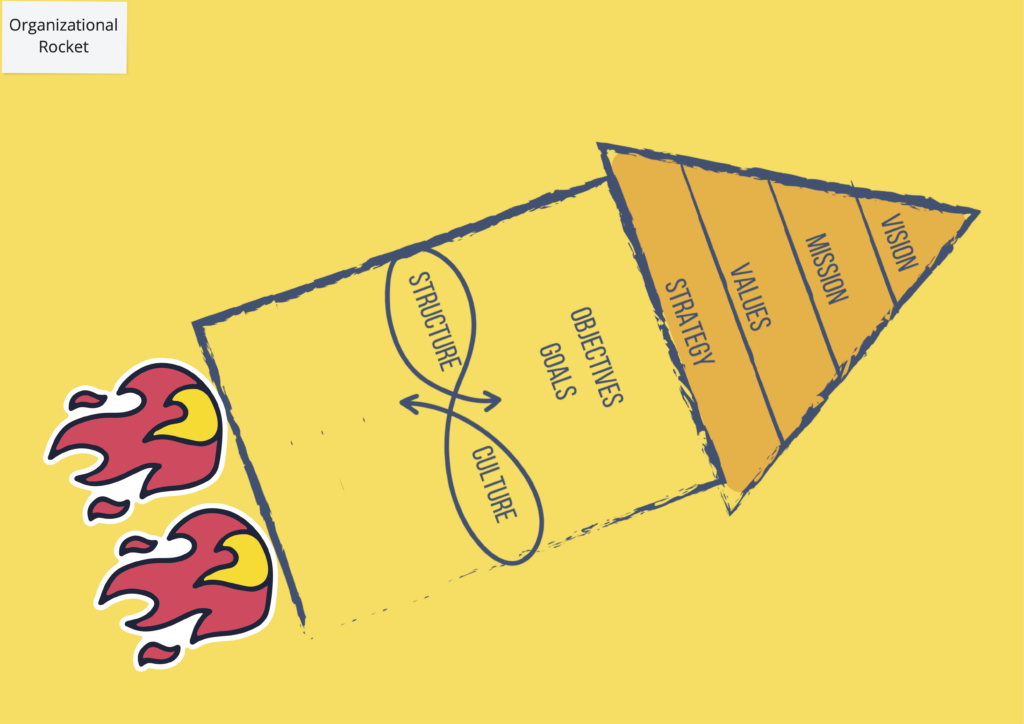
What is the “Organizational Rocket”?


Leadership Compass: “Rocket Leadership

me – leading myself

  • Which part of the organizational purpose resonates most with me? Where am I misaligned?
  • In what ways are my current habits or mental models helping or hindering the system’s ability to learn and adapt?
  • When stress rises, which of my values stays firm—and which one gets compromised first?
  • What internal “structure” (routines, disciplines, reflection spaces) helps me stay intentional as a leader?
  • 🧰 Bonus: Create a personal purpose-structure map:
    • my Purpose
    • my Current Roles
    • my Adaptation Strategy

you – leading individuals

Focus on one person in your work environment:

  • What does this person really need from me: clarity, challenge, care, connection?
  • What unspoken agreements might exist between me and this person—and what would happen if they were surfaced?
  • How can I create role clarity and still invite co-creation and growth?
  • What do I notice in myself when this person struggles? (Do I tend toward… fixing it? … coaching them? … avoiding the topic?)
  • How do my 1:1 relationships reflect or resist the organization’s culture?
  • 🧠 Bonus: Draft a learning goal for this person that connects both to their potential and the strategic needs of the organization.

team – my and my team in the organization

  • How clearly are roles and accountabilities in my team defined — and who created them?
  • How do I model and invite learning from tension, not avoiding it?
  • What systemic structures are supporting—or stifling—the team’s autonomy?
  • In what ways is the team connected to the organizational purpose and strategy? Are they contributing or just “delivering”?
  • What cultural messages are being reinforced in my meetings, events, and decisions?
  • 📌 Bonus challenge: Create or critique a team canvas including: purpose, norms, decision-making model, and feedback culture.

organization – tackling the system

  • Where in the organization are structures misaligned with strategy? Where do roles or power dynamics slow down learning?
  • What would it mean to lead without authority in my situation?
  • What’s the cultural “immune response” to this transformation—and how can it be engaged compassionately?
  • How can I activate the informal system (trust networks, champions) to move the formal one?
  • What does evolutionary learning look like at the system level—and what part can I play in it?
  • 🛰️ Extra Task: Identify one high-leverage experiment that could shift behavior or mindset across teams. How will I know if it’s working?

Organizational Rocket

The Organizational Rocket is a leadership model that explains how organizations move forward with clarity, force, and direction. It makes visible what many leaders sense intuitively: progress is not the result of isolated initiatives, but of alignment between direction, execution, and human energy.


The Front: Direction and Guidance

At the front of the rocket are the guiding elements. They determine where the organization is heading and how it navigates complexity.

  • Vision defines the future the organization is committed to creating. It is a longterm dream and gives orientation and direction.
  • Mission clarifies the organization’s purpose—why it exists and what it contributes.
  • Values set the non-negotiables for behavior and decision-making, especially when trade-offs are hard.
  • Strategy turns intent into direction, making deliberate choices about focus, priorities, and what not to do.

If these elements are unclear or misaligned, the rocket may generate a lot of activity—without meaningful progress.


The Body: Turning Direction into Action

The body of the rocket contains the tactical and operational elements that translate direction into movement.

  • Objectives and Goals create focus and measurability. They connect strategy to everyday decisions and work.
  • Structure and Culture form the internal mechanics of the organization.
    • Structure defines roles, responsibilities, decision paths, and coordination mechanisms.
    • Culture shapes how people actually think, interact, and act—especially when no one is watching.

Structure and culture constantly influence each other. When they are aligned, they reduce friction and enable flow. When they are not, even the best strategy struggles to gain traction.


The Engines: People and Motivation

At the back of the rocket are the engines—the motivation of the people in the organization.

This is where real power comes from. Movement does not originate from frameworks, targets, or processes. It originates from people who are willing to invest energy, take responsibility, and contribute their best thinking.

Motivation fuels commitment, adaptability, and resilience. Without it, the rocket remains technically sound—and stationary.


What This Means for Leadership

The Organizational Rocket makes one thing unmistakably clear: leaders do not create movement by pushing harder. They create movement by aligning direction, enabling execution, and cultivating the conditions in which people choose to engage.

If the organization is not moving, the question is not “Why aren’t people performing?”
The better question is: “What in our direction, alignment, or leadership is draining their energy?”

Because rockets do not move on plans alone.
They move on fuel—and in organizations, that fuel is human motivation.

Leadership Compass: “Four Rooms of Leadership”

Leadership Compass Exercise

The Leadership Spiral is a framework designed to create clarity and orientation for leaders. It does not prescribe solutions. Instead, it gains its power when filled with tools, approaches, methods, and practices that best fit the leader and their context.

One practical way to work with the Leadership Spiral is through structured reflection. The Leadership Compass Exercise uses reflective questions aligned with the four segments of the spiral — Me, You, Team, and Organization — explored in this deliberate order. While leaders are always free to choose the questions most relevant to them, I offer curated sets of questions, each designed to serve a specific leadership purpose.

The “Four Rooms of Leadership” form a foundational set of questions to begin working with the Leadership Spiral. They help leaders clarify their leadership approach, become familiar with the spiral’s segments, and experience firsthand the clarity and impact this model can create.

Pause. Look inward. Move forward with intention.

Leadership does not grow through answers alone. It grows through reflection — honest, sometimes uncomfortable, always clarifying. The Leadership Spiral invites you to return to these questions again and again. Each turn of the spiral offers a new perspective, deeper awareness, and more conscious choice. Use these questions as moments of pause. Do not rush them. Let them work on you.


Leadership Compass: “Four Rooms of Leadership

me – leading myself

  • Write down 3 values that are important to me as a leader.
  • What helps me stay connected to my purpose?
  • What is my personal “compass” in turbulent times?

you – my relationships to the individuals around me

  • What helps other people to open up to me?
  • What role does presence and clarity play in 1:1s for me?
  • How do you handle my own emotions during challenging conversations?
  • 🧩 Bonus : What do I need to let go of to truly empower another person?

team – how can I serve my team best

  • What do I enable vs. control?
  • How do I support psychological safety?
  • How do I balance structure and autonomy?

organization – how can I change today

  • What kind of leadership does my system need from me today?
  • How do I lead across formal structures?
  • What communication, alliances, or structures could change the system?
  • 🏛️ Bonus: What symbols, habits or language would shift the culture?

Returning to the Spiral

As emphasized above, these questions are not meant to be answered once. They are meant to be revisited — with more experience, more honesty, and more responsibility each time. Over time, they are meant to be sharpened – with more purpose, more intention, more experience.

Leadership is not linear, neither is growth.

The spiral continues.